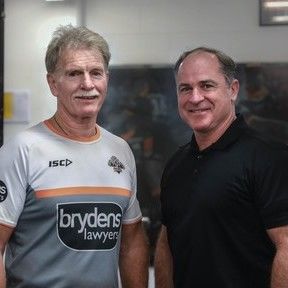

COACHING + SEMINARS + BOOKS for improving Core-Strength, Speed Power and Flexibility for Sport with Legendary Strength Coach - RON PALMER & Fitness Guru' - PAUL COLLINS
+++ GET STARTED TODAY +++
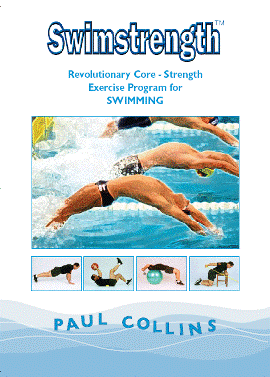
Swimming faster is an extremely skilful thing to do. To move quickly though water requires a swimmer to control their body alignment in extreme physical positions and apply propulsive force to be able to advance without mechanical expense. If a swimmer forces into a position, the orientation of the body within the water will alter, causing an increase in drag forces from lateral and/or vertical motion, slowing the swimmer down.
Conversely, if a swimmer can attain the required position easily but is unable to control their body alignment and stiffness there will be a degree of lateral or vertical collapsing of the body which will increase drag force and decrease their ability to produce propulsive forces.
For many years the model for swimming faster was simply a propulsive model. It was considered that in order to move faster through the water you simply applied more force more often. It was thought that those that could do this swam the fastest. However, we know that weightlifters are immensely strong yet they do not necessarily make fast swimmers. In fact often we see strong muscle-bound athletes unable to swim very fast at all. We also know that while a competitive swimmer may become stronger from lifting weights alone, this does not necessarily transfer to faster times in the water.
This propulsive model does not fit with what we know about hydrodynamics. If an object is in motion within water and you would like to increase its velocity by 10% the increase in the amount of propulsive energy required is approximately 30%. However, you could get the same increase in velocity by just decreasing the objects drag forces by only 3%.
This is not to say that the ability to apply propulsive force is not important, swimming is a constant balancing act, in which you are always trading one thing off for another. For example, velocity is greatest when a swimmer is streamlined and creates the least amount of drag by being long and straight with their arms over their head a metre or so underwater, such as a Butterflyer and Backstroke swimming underwater off starts and turns. The disadvantage of this position, however, it is difficult to breathe and produce propulsion. So the swimmer must trade off and come to the surface and move the arms, resulting in drag forces.
In order to reduce drag forces, The Collins-Technique™ brings attention to detail of the finer details required for developing a swimmers core, enabling a greater streamlined body position and better stroke technique for longer periods of time. The initial objective is build strength endurance and better muscle control in deep postural and stability muscles that support more extrinsic muscles involved in the functional movement patterns of each swimming stroke. The Collins-Technique™ Core-Strength Continuum provides a pathway of core-stability in the direction of improving core-strength. The outcome is having more functional muscle to work with over longer periods.
Today, swimmers are performing on average over 1.3 million arm cycles and 2.5 million leg kicks each year. As a result, a tremendous load is being placed on specific muscles and joints used in each swimming stroke. Such high demand can lead to muscular imbalances, poor postural habits (flat or sway back), scoliosis (spinal curvature), flat feet and many other faulty patterns if core-strength, joint stability and flexibility is not maintained.
Add hyper-mobility, the most common environmental adaptation of the human body associated to swimming, into the equation along with daily lifestyle gravitational forces and even further stress is being directed towards specific muscles and joints.
The ‘holistic’ approach of the Collins-Technique™ being introduced, aims to bring more attention to detail when exercising. These finer details of each exercise movement are key elements that ensure proper body position and correct muscle firing patterns to occur. This, in turn, brings balance back into the muscle, making is work as a unit to protect joint and provide synergistic energy flow.
The Collins-Technique™ also promotes the importance of simultaneously adapting an ongoing Body Maintenance Routine for athletes, just like maintaining a Formula One motor racing team, to ensure the body is functioning efficiently every day throughout the year. Because, if the human body is not prepared and maintained properly, it can also break down just as many Formula One racing cars often do. Linking health professionals and awareness of daily lifestyle factors outside of swimming that can affect posture and muscle balance also need to be taken into consideration in order to reach one’s optimal potential. These elements will be briefly discussed as part of the Collins-Technique™ Muscle Maintenance Plan.
Ongoing muscle maintenance plays a vital role in optimal swimming performance. Developing a good relationship with various health professionals and maintaining a daily warm-up, stability, and stretching and recovery routine correlates well with core-strength improvement and achieving optimal athletic performance all year round. Establishing a regular pre-and-post swim dry-land Body Maintenance Routine is important in keeping the body functioning well. I have developed this approach as a necessary component of the Collins-Technique™ due to the many postural faults and imbalances I readily observe in swimmers. Just because a swimmer may look good aesthetically (muscularly toned), it is the inner framework of the body that generally needs improving, which becomes the main emphasis of this book.
As techniques improve and swimmers become faster, body management outside the water becomes even more important from the grass roots right through to elite level swimmers. My goal as the Body Coach® is to help you identify various muscular and coordination imbalances that maybe occurring and provide a functional pathway of exercises for you to train. As athletes improve, a functional progression to exercise can be applied through the use of Fitness Balls, Medicine Balls, Wobble Boards, Resistance Bands, light hand weights and cable exercises, to name a few.
Taking a few steps back, away from traditional weight training, is crucial in the beginning to help identifying muscular, posture and coordination elements that need attention. It will also help athletes build better body awareness through functional movement patterns using their own body weight and sort out muscle imbalances.
Improved coordination and motor skills through participation in core-strength exercises is a good indication of better muscle synergy. Once the finer details are mastered, progressive overload becomes the goal as muscle start to work together. Otherwise, poor body mechanics, incorrect muscular firing patterns and muscle dysfunction may occur that can be detrimental to swimming.
The primary goal of the Swimstrength™ program is to ensure joint stability, muscular balance and coordination for achieving a better-streamlined body position for longer periods in the water. This ensures a better body position, good stroke technique and less drag forces ... ultimately aiming to improve swimming performance and reducing the risk of overuse injury.
Every athlete will develop at different rates, some faster than others. The goal is to therefore accommodate each individual swimmers needs. Regular testing of movement mechanics, joint stability, motor-coordination skills, balance, spatial (body) awareness, muscle and postural control, bracing and breathing, isometric and body weight strength provide benchmarks for progression. Mastering these skills is very important before adding external resistance to the movements.
The game of golf provides a good example of the application of core-strength for swimming. Golf is a game where almost anyone can pick up a golf club and hit a ball. The problem for most is hitting the ball straight and accurately regularly. To master this requires learning hundreds of fundamental skills. Each one requiring a “back-to-basics” approach to get it right from the start, so the body can adapt to the differing situations in the future. It also requires regular reviews to ensure the proper swing pattern is being maintained. Skipping essential steps can cause imbalances in ones short or long game that are often hard to correct.
In light of this, the Collins-Technique™ is designed to bring attention to detail with corestrength
exercise. Working towards core-strength endurance in the initial phases embraces the current swim training philosophy that has athletes swimming for up to two hours or more a session, twice a day, five days a week. Hence, being able to hold a streamlined body position for longer periods in the water is initially focused on enabling better technique in training. Performing exercises that allowing muscle endurance to occur is generally achieved through the use of progressive body weight exercises.
Returning back to basics may seem hard to accept for experienced swimmers or coaches, but when you consider that water-based swim training goes for two hours, twice a day, five days a week and a race only from 22 seconds up to two minutes (50-200m) you begin to see why core-strength endurance is so important to combat the effects of training. Being able to hold a strong core with good strength endurance allows progression towards more strength and power based activities in the future, which this book also offers.
Swimstrength™, adapting the Collins-Technique™, is designed as an educational tool to assist athletes and coaches alike, from the beginner through to Olympic level. The exercises that follow are organised into relative sections for ease of use. Core-strength essentially provides the fundamental building blocks for linking the core (abdominal) region with the extremities (i.e. shoulders and arms; pelvis and spine; pelvis and legs).
Exercises using Fitness Balls, Medicine Balls, Resistance Bands and light hand weights are also included to help provide variety to your training and improve your streamlined position in the water.
Whether you read this text as a coach, competitive or recreational swimmer, I hope it will encourage you to learn more about musculoskeletal functioning and the benefits of regular core-strength, stability training and muscle maintenance as part of the Collins-Technique™ Core-Strength for Swimming Program.
CUT & PASTE this link for more information - - - https://coachcollins.github.io/SportsStrength/
# Quality Training Resources available to you at an affordable price (books / ebooks)
# 1-on-1 mentor Coaching available with Coach Palmer and Coach Collins (contact us)
# Team training sessions (one-off, fitness testing, staying on track)
# POSTUREFIT - Athlete body management, stretching and re-alignment (contact us)
# Seminar presentations available for athletes, coaches, teams, clubs, sporting associations, schools
# Corporate business seminars in the Workplace, Business Conferences and Conventions (contact us)
"Sports Strength provides the platform and guidance from which appropriate physical conditioning can be enhanced whilst developing one's playing skills and good character – making it an essential read for players, coaches, teachers and parents."

Coach Palmer +
Coach Collins™
They say you can’t buy experience. Well that’s lucky for us all because imagine the bill for over 100 years of it!
I have known both Paul Collins and Ron Palmer for over 25 years ...... Quite simply, you are in good hands. Paul and Ron are the best in the business when it comes to Optimising Athletic Performance, and “Sports Strength” will allow you the reader, to absorb every inch of what it takes to play your chosen sport in the best possible physical condition
You will be shown how you can prepare yourself to play at your peak with user-friendly systems that not only show you how to train, but also how to recover and relax, which is an essential ingredient for success.